Please be aware this post contains affiliate links to bookshop.org
This year, I find myself re-entered the realm of ARCs on NetGalley. My first go-around with this platform was a bit of a fail. I got overwhelm and ended up not finishing one of the two ARCs I had decided to read and I felt horrible about.
I took a step back out of respect to the authors and publishers that were looking for insight into their books. Now that I find myself in the throws of a new love affair with reading again, I’m giving it another go.
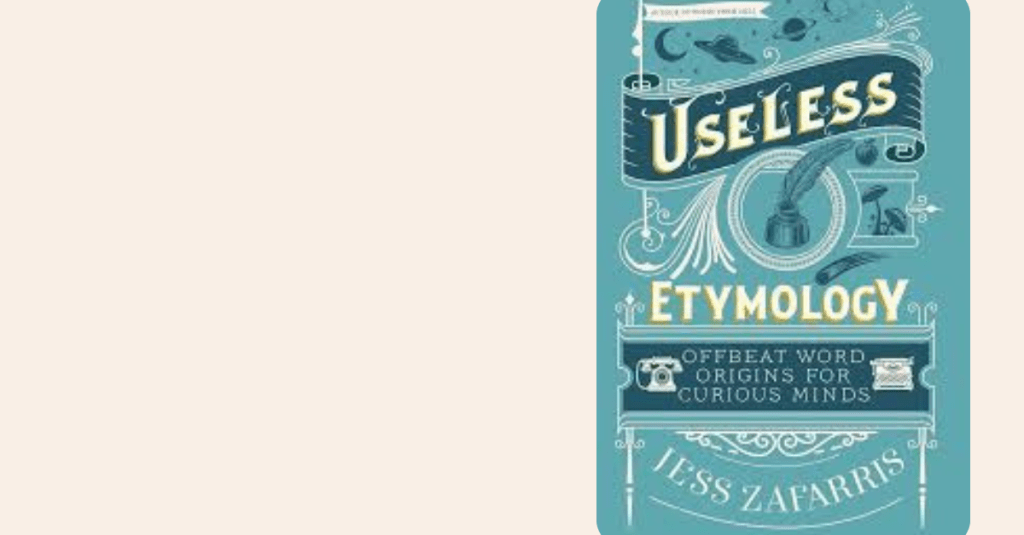
If you’ve been following me for a moment, you know that I like to throw in a random reference book from time to time–dabbling in sociology, psychology, and linguistic pursuits for the most part. When Useless Etymology popped up in NetGalley’s available titles section I knew I had to read it. By the description, I knew that if it was anything like Thirty-Two Words for Field, I would love it.
Well, dear reader, it was pretty darn close.
Useless Etymology Review

3.75 on StoryGraph
Genre: Nonfiction Reference / Etymology
Author: Jess Zafarris
Page Count: 336
Publication Date: October 7, 2025
Useless Etymology: Offbeat Word Origins for Curious Minds is filled with a ton of fun factoids (and aptly including the etymology of the word, “factoid”) for the word nerd in all of us. While a rudimentary understanding of linguistics and etymology may be helpful when reading this book, it isn’t necessary. Jess Zafarris (I’ll be calling her Jess from here forward in this review) does a fantastic job of simplifying the complexities that come with language development. She turns a somewhat dense subject into a conversation anyone with a love for English can enjoy.
I particularly appreciated the random moments scattered throughout that showed etymology through a female lens (shoutout to Jess for being the female etymologist us word nerd girlies need). A few of my favorites included the etymology of the words spinster (pg. 42), female (pg. 71), midwife (pg. 153), period (pg. 170), and gossip (pg. 263-265).
This book is broken down into three parts, each one a bit more advanced than the last. Part 1 is a bit of a crash course in etymology, going back into our Norman roots and the different ways words and phrases are built. Jess gets into the science and mathematics (but not scary math–just word math) behind word construction and does an artful job of using examples to demonstrate the way a certain formula works.
Part 2 ventures into specific categories of everyday words, including colors, animals, food and space. My personal favorites within this section had to be the chapters focused on literary and publishing words. It was an extremely meta experience for a bookworm like me (and I’m using meta in the original sense of the word NOT Mark Zuckerberg’s). Why I had never thought about the French roots of the word plot or realized the word stereotype first started in the printing industry is beyond me, but now I know their roots and more, thanks to Jess.
My favorite part by far had to be Part 3. So much of the English language is rooted in misunderstanding, miscommunications, and misspellings of words and, in Part 3, Jess explores how silly word development really can be. As someone who has always struggled with these very issues with the English language (yes, even with an English degree I still suck at spelling) this portion of the book made me feel SO much better about my butchery of my native language. For all I know, my botch job of the modern-day interpretation may very well be closer to the word’s origin than it is today. Throw in some fun references to Marvel and The Simpsons, and Part 3 won my heart.
As it goes with any non-fiction reference book, there were a few portions of this work that made my eyes glaze over. But, as Jess points out in her intro, this book is built for you to do just that–reference! If you decide to give Useless Etymology a read and are an etymological novice, I highly recommend starting on Part 1, and exploring Part 2 and 3 from there. If you have a bit more experience with the nuances of language building, feel free to prance around the pages to your heart’s content.
I’ve always loved having random tidbits dancing around in my head and Useless Etymology satisfied that itch for me from page 1. If you want to get a taste of Jess’s style before this skinny thick book of hers is released on October 7th, give Jess a follow on Insta, check out her blog, “Useless Etymology,” or give her podcast, “Words Unravelled,” a listen! As for myself, I’ve already found the perfect spot for my hard copy: right between my MLA and AP Style Guides.
Thank you NetGalley for the ARC and for introducing me to Jess Zafarris.
 The Book Nook Chronicles
Leave a comment