Erica’s Experience
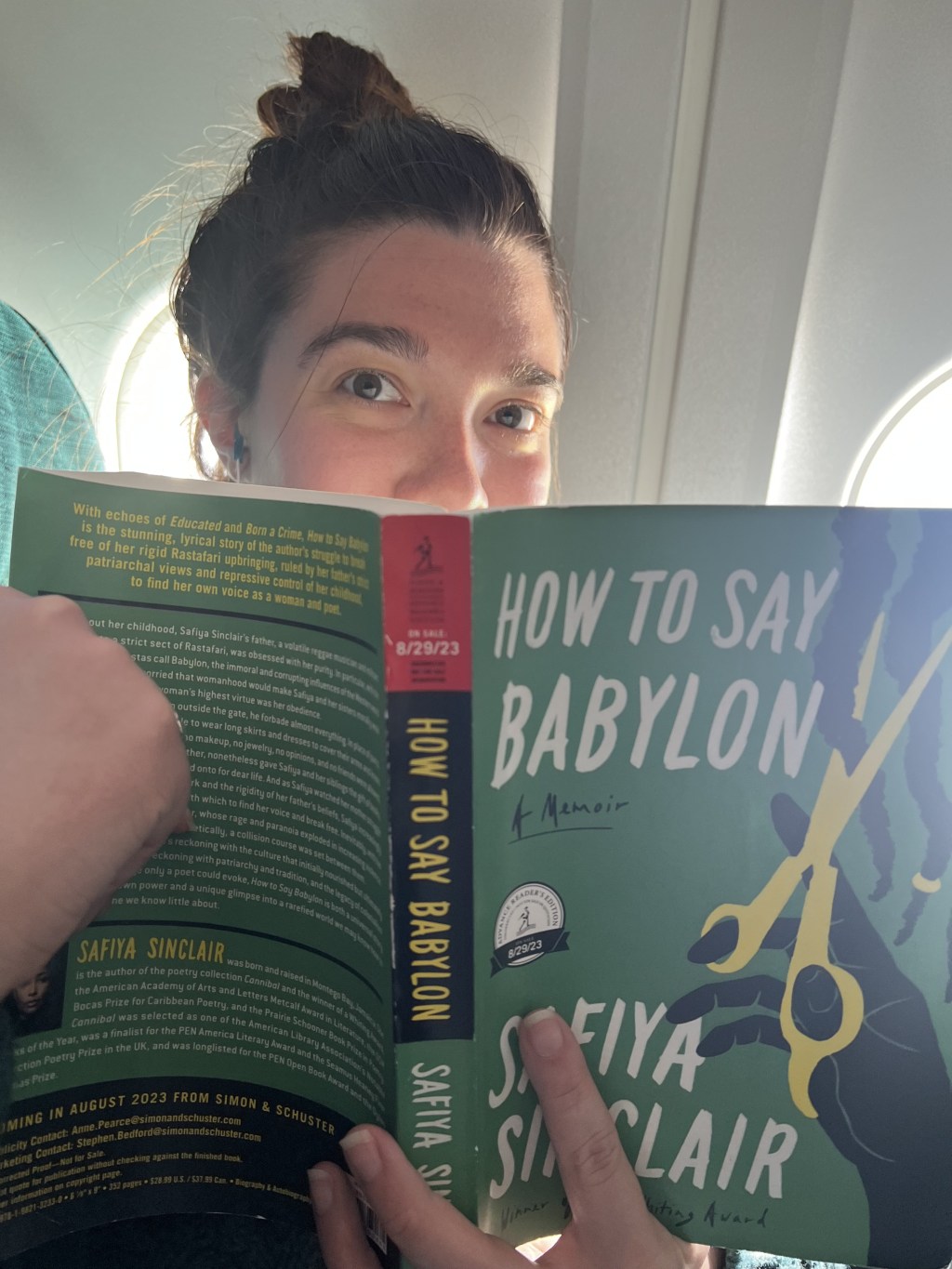
Title: How to Say Babylon
Author: Safiya Sinclair
Genre: Memoir
Page Count: 329
Publication Date: October 3, 2023
Interested? Buy How to Say Babylon
I’m extremely excited to share that this is my very first advanced reader’s copy review of a book through Simon & Shuster’s Book Buddies. While it may seem like a small step in my book blogging journey, I’m really proud of myself for getting to this point. Here’s to celebrating the small wins.
Review
Compared to Born a Crime (one of my all-time favorite reads of this decade) and Educated, How to Say Babylon is a decadent autobiography by one of Jamaica’s most notable poets from the millennial generation, Safiya Sinclair. Sinclair grew up as the oldest daughter in a strict Rastafarian household, where her father expected her and her sisters to be obedient, docile, and pure women from day one. Having learned a little bit about Rastafari after finishing When We Were Birds by Ayanna Lloyd Banwo, I was instantly intrigued by Safiya’s story. Rastafari is thought to be a passive lifestyle often associated with Bob Marley. However, Sinclair’s memoir showcases the darker sides of the movement, opening up about Jamacia’s prejudice towards the lifestyle and the blatant sexism practiced by most Rastafarian men.
Safiya’s father was a very troubled man who turned to Rastifari in his teens–drawn to the movement’s rebellious pan-African politics and skepticism. Her mother, on the other hand, who became a Rastafarian after meeting Safiya’s father, fell in love with the movement’s peaceful passivism. The two blended to create a complicated home for their four children (three girls and one boy).
Safiya’s father taught his children that modern society, or Babylon, was unpure and therefore untrustworthy, while her mother opened their minds with books and education. In the end, this resulted in Safiya becoming a walking contradiction: a fiery and independent wunderkind determined to please her father while silently questioning his beliefs. As her father becomes physically and mentally abusive to Safiya and her sisters, she turns to poetry as a means of escape.
I am a real sucker for a good memoir and Safiya Sinclair has written a great one. Reading people’s stories is the simplest way we can grow. It allows us to see humanity in a different way, even if only for a couple of days. This memoir is for anyone who has ever felt othered when they were supposed to feel at home. It’s a true lesson on the power of self-acceptance. Safiya explores the complex dynamics of standing up for yourself while finding the space and grace to forgive. Her prose is unsurprisingly poetic and her everchanging relationship with her father is a perfect example of how people always have the ability to change (if they have the will and sense to do so).
I found Safiya’s struggles comparable to those of women brought up in extreme Christian households. Not allowed to wear pants, unable to have non-Rastafarian friends, forced to keep her signature Rastafarian dreadlocks, and taught the same scare tactics used in abstinence-only education, Safiya is trapped in the confines of a world that will never see her as an equal or an individual. While my own experience with religion isn’t quite as dark or intense, I know how lonely and troublesome it can be when you are the oldest daughter in a conservative household. There’s nothing you would rather do than please your parents, even if you’re questioning them. You do your best, sometimes even better than your best. In the process, pieces of you are caged up inside–never dying, but never fully free.
While her upbringing was tumultuous, there was something truly beautiful in Safiya’s story, outside of her finding her voice through her pen. It was her relationships with the powerful women in her life–her grandmothers, her aunties, her mother, and her sisters. Safiya’s matriarchal role models are her driving force, her saviors, and her strength. They are the ones that set her free. In a world that often makes women feel small, the female-fueled support in this memoir shows how important it is for women to lift each other up. It’s a truly pivotal way we can change the world around us for the better.
You can purchase How to Say Babylon here.
 The Book Nook Chronicles
Leave a comment